




Skip to product information
1 of 14

Sex Talk Toolkit + Bonus Tools

Sex Talk Toolkit + Bonus Tools

You need to explain sex to your child.

Regular price $32.00 USD
Regular price Sale price $32.00 USD
Sale Sold out
Shipping calculated at checkout.

Work out what your child is ready for, and what can wait

Explain it in words they'll understand, at their exact age

Add your own family's values and boundaries around the facts

Keep going when they giggle, say "gross", or go quiet

Maybe they asked. Mid grocery shop, while you were juggling bananas and a fussy toddler: "Mum, how are babies made?"

Maybe puberty's turned up and, well, isn't that when your parents told you? At least that's how it always goes on telly.

Or maybe nobody asked anything at all. You just looked at your child and thought, I should probably say something.

However you got here, the question's the same: how much do you actually say?

That's what the Sex Talk Toolkit is for.

It works out what your child needs to know right now, gives you the words they'll understand, and helps you add your family values around the facts.

It's all built around my Sex Talk Roadmap - the four stages of explaining sex, from where babies grow through to understanding sex more broadly. You don't have to learn it. The toolkit works out which stage your child is up to and takes it from there.

Because the goal isn't to tell them everything. It isn't to say as little as you can get away with, either. It's to give your child what they're ready for - enough that it makes sense to them, and not so little that they're left to work the rest out on their own.

What you'll be able to do

  • Work out what your child is ready to know right now
  • Explain it in words your child will actually understand
  • Cover just the part you're stuck on, instead of everything at once
  • Start the conversation yourself, rather than waiting to be asked
  • Add your family's beliefs, expectations and boundaries around the facts
  • Keep the conversation going when it doesn't go the way you expected

Here's what's inside

Where your child is up to → what to say → how to bring it up.

SEX TALK GPS
Work out where your child is up to on the Roadmap. Whether it's time, and which of the four stages your child needs. It weighs up more than age: what your child already understands, what's on their radar, what's coming as they grow, what they're likely to run into, and whether anything's changed lately.

SCRIPT BUILDER
Work out what to say for that stage, at their age. Pick their age, the stage you're explaining and the part you're stuck on, and you'll have the words to say it out loud. Comes in inclusive or traditional wording, with extras you can add if you want to go further. 

CONVERSATION STARTER
Work out how to bring it up. Four ways in, for when you'd rather not wait to be asked: through a book, a teachable moment, an everyday conversation, or just saying it straight.

Those three are the ones you'll reach for.

You'll also find a few extra tools tucked in, for when it's something other than the words that's in the way - the Fear Buster for when worry or doubt makes you hesitate to start, the Troubleshooter for when they laugh, say "gross" or won't talk about it at all, the Values Finder for putting your family's beliefs and boundaries around the facts, and the Neuro Adapter for when it's the explaining that needs to change rather than what you say. They're there when you want them.

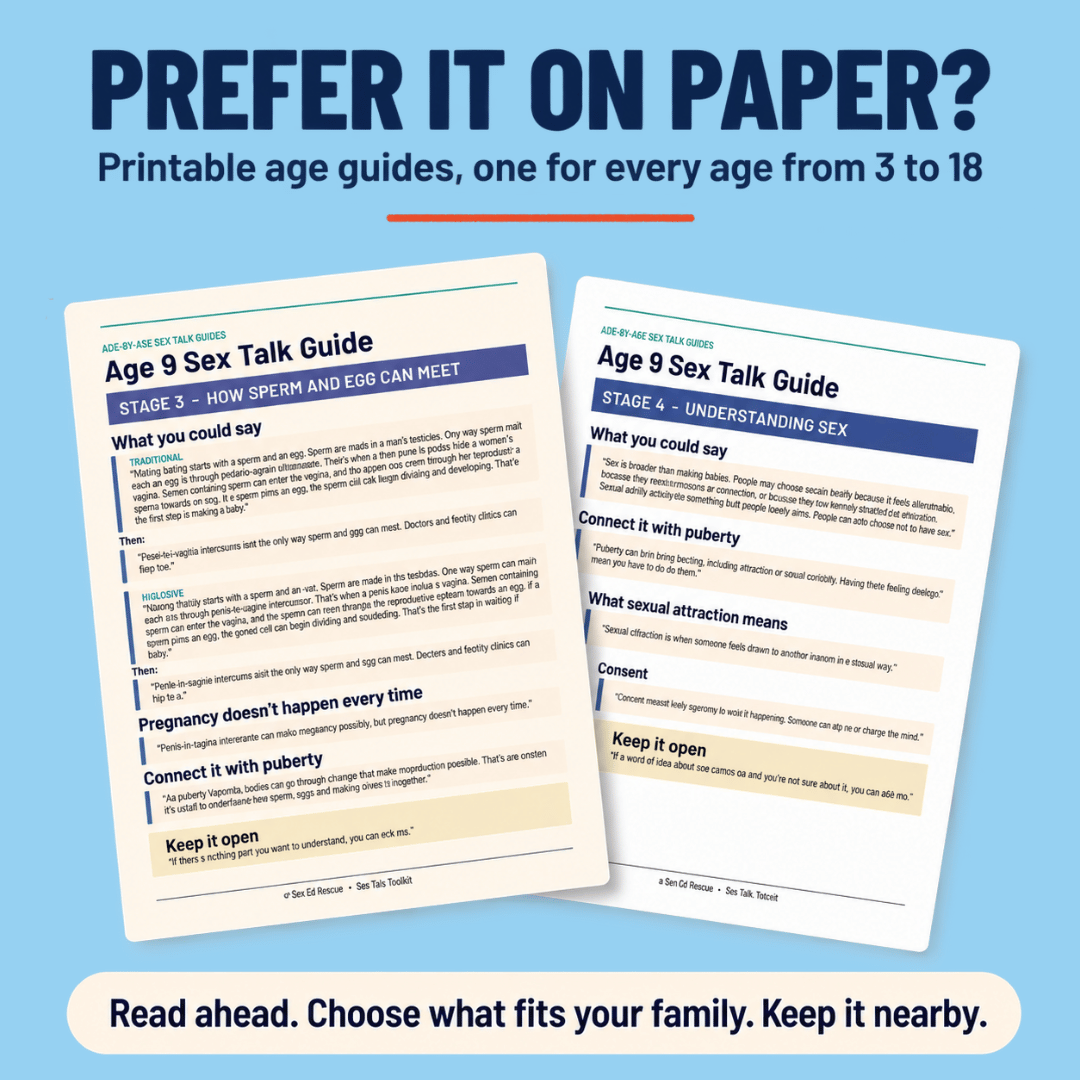
Prefer it on paper? The same guidance comes as printable age guides, one for every age from 3 to 18 - handy if you'd rather read ahead, highlight the wording that fits your family, keep something nearby for the moment itself, or work from paper rather than the online tools.

Printable age guides
One for every age from 3 to 18, to read ahead or keep handy.

And for the bits that trip parents up:

And for the bits that trip parents up - 4 bonuses, included

The three tools above get you through the conversation itself. These four are for everything around it.

BONUS 1 - VALUES FINDER
Work out what your family believes, before you have to say it out loud.
The facts are the same in every home. What's different is what your family believes around them - about relationships, privacy, timing, and what you expect of your child as they grow. Work out where you actually sit, and you'll know what to add around the facts. So the explanation sounds like you, rather than something read out of a book.

BONUS 2 - FEAR BUSTER
Name what's actually stopping you, and get past it.
Parents who haven't started usually aren't stuck on the facts. They're worried they'll say too much, plant an idea that wasn't there, or get it wrong in a way that can't be undone. Pick the worry that's actually yours and work through that one. It's usually the difference between meaning to have the conversation and having it.

BONUS 3 - TROUBLESHOOTER
For when the conversation doesn't go the way you planned.
They giggle, say "gross", go quiet, change the subject - or you get halfway through and lose your nerve. It's the part nobody warns you about, and it's where parents decide they're bad at this and quietly stop. A child laughing is a child who's uncomfortable, not a child who's been harmed. Find what happened, and you'll know what to do next.

BONUS 4 - NEURO ADAPTER
Change how you explain it, for the child in front of you.
Adapt for literal thinking, processing time, sensory needs, attention or communication - including for autistic and ADHD children. Adjust the wording, the format, how much detail and the pacing, until it fits the child you've got. The facts stay the same. The teaching changes.

All four are included. Use the ones you need, when you need them.

Worried about saying too much?

Children who get accurate, age-appropriate information make safer choices, not riskier ones. Staying quiet doesn't keep a child innocent - it just means they learn it somewhere else, without you in the room.

And you probably need to say less than you think. A four-year-old asking where babies come from usually just wants to know the baby grows in a uterus. That's it. The toolkit tells you where to stop, which turns out to be just as useful as knowing where to start.

What changes

  • You know what this conversation needs to cover, before you start it
  • The words are ready before the moment arrives
  • When it gets awkward - and it might - you know what to do next

Who it's for

Parents and carers of children aged 3 to 18.

Your family might be religious, secular, conservative, progressive, or somewhere in between. I provide the facts and the words. You add your own family values around them.

And it works whatever your family looks like - same-sex parents, single parents, step and blended families, and children who came along through donor conception, IVF, surrogacy or adoption.

It's for neurodivergent families too - whether that's your child, you, or both of you. If your child needs things explained more literally, in smaller pieces, or with more time to process, there's guidance inside on how to explain it in a way that works for your child. The facts stay the same.

Even if your child is older and you've never said a word about any of this - you're not too late. You just start from where they are today.

About Cath

I'm Cath Hakanson, a nurse, midwife, sexologist and family sex educator with more than 30 years of experience. Being a midwife gave me a head start on the facts. Finding words a four-year-old could actually understand took a lot longer.

I'm also a parent who's had to find these words at my own kitchen table. I'm an autistic ADHDer, raising neurodivergent kids of my own. That combination shapes the way I teach: clear, practical, direct, and focused on the child in front of you.

No judgement. Just practical help with what to say next.

What this doesn't cover

Each of my toolkits does one topic properly, rather than a bit of everything. This one is explaining sex: what it is, how babies start, and how much to say.

If what you need is puberty or talking about masturbation, there's a toolkit for each of those.

Know what to say, before they ask again.

Get instant access to the Sex Talk Toolkit - and explain it in a way that fits your child, and your family.

Age

How it works

FAQ

Guarantee

For parents and carers of children and teens aged 3 to 18 years.

How do I know if my child is old enough?
That's what the GPS is for. It weighs up where your child is at and tells you whether this can wait, or needs saying now.

What if they ask something I can't answer?
Pick that part in the Script Builder and you'll have the words. And "let me think about that one" is always a fair answer.

What if my child doesn't want to talk about it?
Common, and not a sign you've done it wrong. The Troubleshooter covers going quiet, changing the subject and shutting it down — and what to try next.

They've already heard about it from friends. Is there any point?
More than ever. Yours is the version that sorts out what they've picked up wrong, and tells them they can come back to you.

Our family doesn't look like the one in most sex ed books. Will the scripts still work?
Yes. The explanations cover the different ways families are made and babies are started, so you're not left rewriting a script that assumes a mum and a dad.

Will this work for my autistic and/or ADHDer child?
Yes. If your child needs things said more literally, in smaller pieces, with more time to process, or in a different format altogether, there's guidance inside on how to adjust for that — and for sensory needs, attention and communication too. The facts stay the same. The teaching changes.

💡 Still wondering about something? Just reach out – I’m always happy to help.

Won't explaining sex take away their innocence?
Innocence isn't the same as not knowing. A young child can be told how a baby starts and carry on exactly as they were, because they don't hear it the way an adult does. What unsettles a child is finding out by accident, or from someone who makes it sound shameful. In 30 years, the children who struggled weren't the ones who'd been told. They were the ones left to work it out on their own.

Won't knowing about it make them want to try it?
It's the fear that keeps most parents quiet, and it works the other way round. Children who get accurate, age-appropriate information make safer choices, not riskier ones. Knowing how something works isn't the same as being told to go and do it.

Nobody has asked me anything. Isn't it too early?
Probably not. It's a much easier conversation with a child who isn't embarrassed yet, and by the time they start asking, they've often picked something up somewhere else already. The Sex Talk GPS looks at your child rather than their birthday, then tells you which stage they need, or whether this one can wait a while yet.

My child is older and we've never talked about it. Have I left it too late?
No. There's always more ahead of them, and an older child who's picked things up from friends or online needs you more, not less. Yours is the version that sorts out what they've got wrong and tells them they can come back to you. Start with the GPS, so you're working from where your child is today instead of trying to catch up on all of it at once.

I'm dreading this one. Nobody ever explained it to me.
More common than you'd think, and worth naming rather than pushing through. The Fear Buster helps you work out which worry is actually yours, whether that's saying too much, putting an idea in their head, or getting it wrong in a way you can't undo. You don't have to feel comfortable to do this well.

I don't want to just hand them the facts. How do I get our family's values in there?
The facts are the same in every home. What changes is what your family believes around them, about relationships, privacy, timing, and what you expect of your child as they grow. The Values Finder helps you work out where you actually sit, so you know what to add and what to leave for later. It's the difference between an explanation that sounds like a textbook and one that sounds like you.

What if I say the wrong thing, or freeze halfway through?
Then you say so, and you come back to it. The Troubleshooter covers the parent side too: freezing, rambling, saying more than you meant to, realising afterwards you left something out. Very little can't be fixed with "I had a think about what I said yesterday."

My child giggles, says "gross", or won't talk about it at all.
Common, and not a sign you've done it wrong. A child laughing is a child who's uncomfortable, not a child who's been harmed. The Troubleshooter covers giggling, "gross", going quiet, changing the subject and shutting it down, and what to try next. Small comments in the car or at the sink land better than a sit-down talk.

Will this work for my autistic and/or ADHDer child?
Yes. The Neuro Adapter changes how you teach it: more literal, smaller pieces, more processing time, and adjustments for sensory needs, attention and communication. It matters more with this topic than most, because so much of the usual language is hints and softened words that a literal thinker will take at face value. The facts stay the same. The teaching changes.

Our family doesn't look like the one in most sex ed books. Will the words still fit?
Yes. Nothing here assumes a mum, a dad and a baby that arrived the usual way. The explanations cover the different ways families are made and babies are started, including same-sex parents, single parents, step and blended families, donor conception, IVF, surrogacy and adoption. The wording comes in an inclusive version as well as a traditional one, so you can pick what sounds like your family. What your family believes about relationships, marriage or timing is yours to add on top, and the Values Finder is where you work that out.

30-day no-hassle money-back guarantee.

View full details
Sex Talk Toolkit + Bonus Tools $32.00
Add to cart
What other parents think of this product

Customer Reviews

Based on 7 reviews
100%
(7)
0%
(0)
0%
(0)
0%
(0)
0%
(0)
A
A.
Perfect guide for talking to kids

This helped me so much when talking to my 6 year old who had lots of questions about how "babies get into a belly". This guide gives many different ways to speak about sex depending on your familes views and values. It gives you a way to speak about as many or as few details as you are comfortable with or that you think your kid is ready for. I appreciate how well written and thought out this was. I'll be using it in the future for more open talks with my children.

A
Anonymous
I love the illustrations

My kids are super curious about where babies come from, so I grabbed this to help me explain. The illustrations at the back are great, as I they helped me to explain. and answer their questions. Thank you!!!!!!!

C
C.D.
Great place to start!

Our daughter was very curious and was asking about pictures, this gave us a nice intro and gave her clear specific information appropriate to her age.

S
S.P.
100% recommend

Reading "explaining sexual intercourse" gave me the piece of mind and back up I needed, reinforcing what I knew and offering precious new knowledge, in order for me to feel more confident and as ready as possible for whenever the time comes for educating my child on the matter.

B
B.B.
Great resource for those of us who are overwhelmed

I grew up in a conservative home and my sex education was abstinence-only, catholic school education. I knew I wanted to do better by my kids but didn't know where or how to start. Cath broke it down into step-by-step instructions that eased my need to deep dive into researching the healthiest way to approach the subject of sex. She did all the hard work for me! She provides different prompt recommendation depending on your family's values which I really appreciate. I didn't have any examples of a healthy conversation growing up but Cath gives excellent suggestions to get you started - no matter how much or little you want to share. I ended this course feeling relieved, directed and confident that my kids will have a healthier relationship with sex than I ever did. It is a must have, first step for any adult looking to do better!

J
J.C.
It was good!

I really appreciated how the topics were broken down to simplify sensitive topics for kids. It made it manageable with a topic that can be uncomfortable.

  • DOWNLOAD

    Instant, digital access. Easy, Fuss-free, low tech.

  • LEARN

    Bite-size practical information with everything you need to educate your child.

  • TEACH

    Honest, open conversations to empower your child, your way.

Trusted by 1,000,000s of families globally